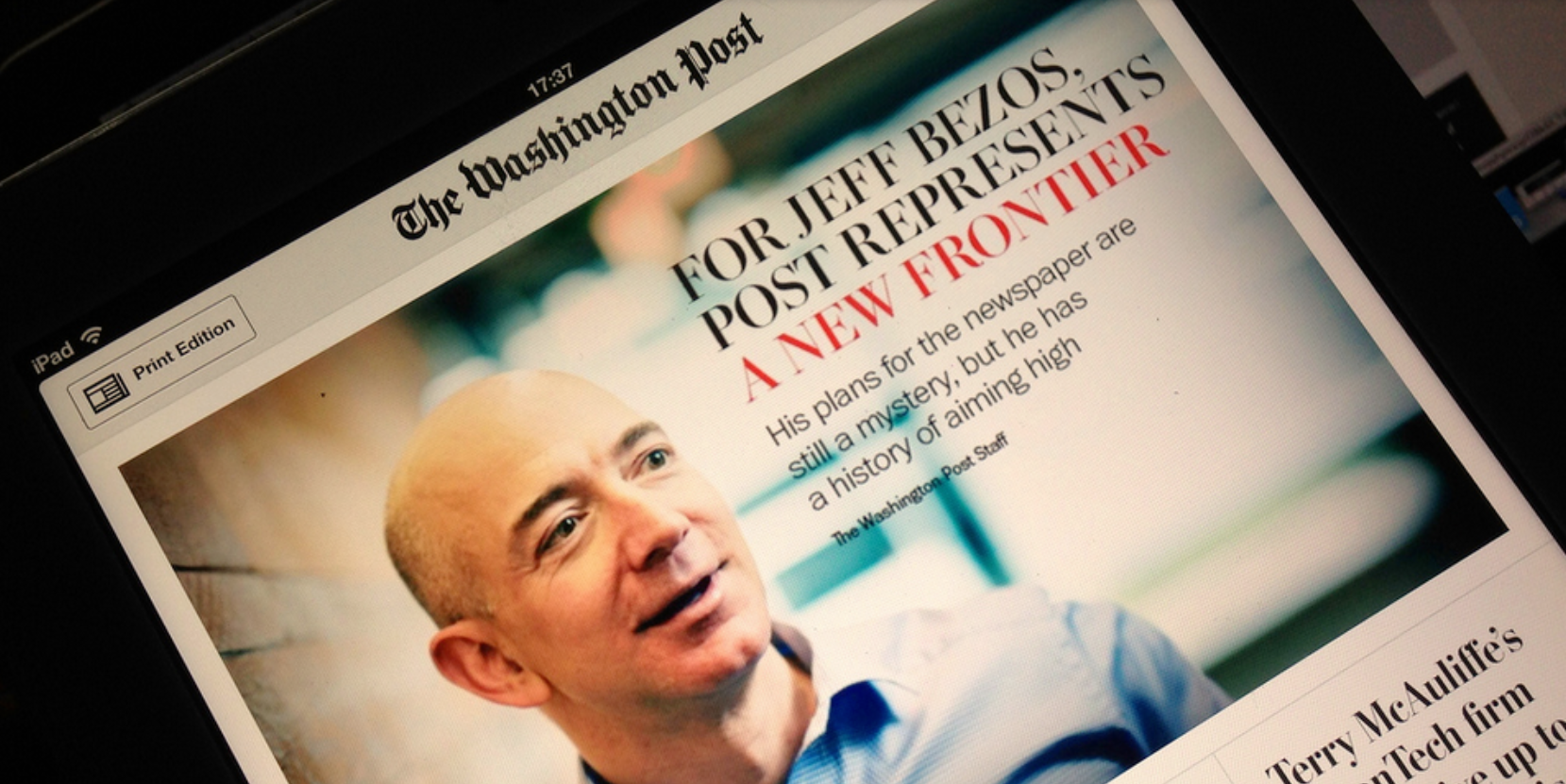
I tire of pathetic postings by the former, current journalists, or journalism professors, who blame Jeff Bezos for terminating a third of The Washington Post’s newsroom staff. Are you so childish to expect that Bezos (or any other billionaire or millionaire) should forever subsidize your increasingly money-losing enterprises which have lost three-quarters of their consumers during the past 20 years because you either myopically or dim-wittedly failed to perceive and comprehend the profound, indeed epochal, changes already well underway in the media environment worldwide? Or are you so simplistic as to think that Bezos (or any of his ilk) could reverse or even stop the seismic dynamics that are dooming legacy media (no matter whether that media are in print, broadcast, or online)? Stop sucking your ink-stained thumbs.
When during the 10th Century powerful King Canute went to the beach and commanded the tides to stop, did his courtiers and subjects condemn him because the tides didn’t stop? Besos’s subsidization of The Washington Post these past 13 years has likely kept that newspaper publishing better and longer than it might had not one of the world’s richest men owned it. (Ask the Pittsburgh Post-Gazette, a newspaper even older than the District of Columbia itself, about that.)
I’ve worked as a journalist for daily newspapers, then as an executive for News Corp., Reuters, and the old United Press International. Yet more recently, during my nearly 20 years as a postgraduate professor of Media Management, I’ve found that journalists’ detachment or ignorance concerning the real (by which I mean not the superficial) causes of their industries’ catastrophe staggers me. The irony of that, in a trade in which a frequent purpose is to exposes and explains problems, is awesome!
Since the beginning of the millennium, I’ve been reading journalists and media ‘pundits’ who blame bogeymen or superficial factors for their industries’ catastrophe: feckless tycoons, hedge funds, corporate chain ownerships, dividend pressures from Wall Street, etc. Columbia Journalism Review Publisher Evan Cornog in 2005 even penned an tongue-in-cheek essay entitled ‘Let’s Blame the Readers’ (an essay which suspiciously has since been removed from CJR’s online archive but is still available elsewhere). If you’re going to vent about a bogeyman, why don’t you do something constructive instead with that otherwise wasted energy and solve the actual problems nowadays cratering the journalism industry?
Because I’m writing about mass firings at the The Washington Post, let’s do focus on the U.S. daily newspaper industry as an example. That industries’ declines began after 1984, the year when daily newspapers consumed per capita (also per household) in the U.S. reached its peaks. Some pundits might respond that during the subsequent 20 years U.S. daily newspaper circulations increased in sheer numbers, but I retort that not when adjusted for U.S. population growth. Likewise, although that industry’s revenues grew steadily from 1984 through 2004, they didn’t when adjusted for inflation. Thereafter (not coincidentally once more than 50 percent of U.S. households and offices gained broadband Internet access), the industry’s circulations, advertising revenues, and gross revenues began to drop precipitously. The U.S. newspaper industry has lost more than seventy-five percent of its readers, its advertisers, and its revenues, during the past 20 years.
Were feckless tycoons, hedge funds, corporate chain ownership, dividend pressures from Wall Street, or other bogeymen the reasons why? Compare the declines during the past 20 years of independently owned and operated newspapers versus those not owned or operated by multi-newspaper corporations, publicly-traded corporations, or hedge funds. You’ll see that the declines in circulations, advertisings, and revenues, of all U.S. newspapers are statistically similar (and even if you simply graph those declines). None of these bogeymen are why the U.S. newspaper industry has fallen off a fiscal cliff.
Some journalists and ‘pundits’ claim the cause for the declines is consumers shifting their news consumption habits from legacy forms of media (print or broadcast) to online forms (websites or streaming). For the newspaper industry, this begs the question of why the packages of news have been popular and lucratively successful in print aren’t when online, particularly when websites had been heralded as the industry’s saviors and future. All U.S. daily newspapers have been operating news websites now for at least 20 years, more than enough time for conclusive judgements of that strategy to be made. During these 20 years, the industry’s annual gross revenues from their printed editions has plunged from $43 billion to $19 billion, yet the industry’s annual gross revenues from its websites has risen to less than $4 billion – hardly enough to compensate. It is a clearly a disastrous strategy.
An excuse some journalists and current newspaper executives claim for why newspaper website revenues are relatively small is because consumers have ‘become habituated’ to not paying for website contents due to newspapers decades ago not charging for access. That excuse is bullshit, as I and other industry veterans verifiably know. From the mid-1990s through the first decade of this century, scores of daily newspapers attempted unsuccessfully to get their consumers to pay. Newspapers that during the past 15 years have launched paywalls’ are experiencing the same insufficient results as newspaper 20 to 25 years ago experienced. With the rare exception of national daily newspapers (which in the U.S. is less than 1 percent of the industry), newspapers websites are getting fewer than one out of every 50 online users to pay a subscription.
Look wider. The declines of the daily newspaper industries in Canada, 22 of the 27 European Union nations, Australia, Japan, Israel, Singapore, Malaysia, the Republic of South Africa, and many other nations remarkably parallel the declines of the U.S. daily newspaper industry. So, stop simplistically blaming newspaper owners for these declines and focus instead upon the people in the newspaper industry who best know its products. (Hint: if blame be placed, the local will be much closer to the newsrooms than newspaper executives’ suites.)
The fundamental causes of the epochal transformation already well underway in the media environment have been my professorial focus since the summer of 2006, when I saw the U.S. newspaper industry choose the wrong path to adapting to computer-mediated technologies. Since 2018 by invitation, I’ve been presenting academic papers about this to international symposia such as the biennial World Media Management and Economics conferences, International Media Management Academics Association, etc.
Unfortunately, media academe generally (or perhaps I should bluntly say overwhelmingly) follows rather than leads its industries (in contrast to academes of medicine, general sciences, law, computer sciences, etc.) Plus, Mass Media industry executives in the U.S. don’t read media management professors journals or attend academic conferences (I’ve never known any to do so unless they were invited as a speaker). Regrettably, the result is that media academe largely isn’t providing solutions to the media industries faced with grave, indeed existential, problems.
Moreover, although I’ve consulted to the media industries for 30 years, I’ve long found that, with rare exceptions, ‘You cannot solve a problem with the same minds that created it’ – a popular quote apocryphally credited to Albert Einstein, who instead actually said, “A new type of thinking is essential if mankind is to survive and move toward higher levels”. The ‘new media pioneers’ who guided the U.S. daily newspaper industry onto the wrong path years ago have vested interests to state that the path must continue to be pursued (20 years isn’t enough?) apace even though it should be glaringly evident this path has failed and will lead to the extinction of that industry. Furthermore, a generation of new executives who’ve since replaced those pioneers, and whose expertise has become managing the obvious declines, likewise resist the dire need for grave change. Like someone who has fallen far, the newspaper industry’s accelerating momentum downward increasingly resists gravely necessary redirection.
Now in my seventies, I’ve retired from teaching. I nowadays still consult, but no longer to media executives. Instead, my clients are private investors (where bigger consulting fees are). I’ve also sold my family’s 140-year-old daily newspaper company. However, my DNA arose from five generations of newspapering. Some opportunities can still be salvaged by that industry.
For the past two months, I’ve been at home in the Canary Islands writing not another academic paper U.S. media executives will never read but instead an explanation for the industry’s laymen about: (1) what wrong path the Mass Media industries took attempting to adapt to computer-mediated technologies and what has resulted; (2) why that path was disastrously wrong; (3) what the Mass Media industries instead should have done; (4) why and how journalists and academicians inadvertently hampered their industry’s successful adaptation; and (5) what opportunities the Mass Media industries might still be able to salvage. I plan to publish this five-part essay here during the northern hemisphere spring season.
Meanwhile, stop blaming Bezos – a former Washington Post newspaper delivery boy whose purchase of that newspaper 13 years ago was a centi-billionaire’s equivalent of a good deed. I expected him several years ago to cut its newsroom by at least a third, so wasn’t surprised now that he has. Did you notice that at the same time he cut 16,000 corporate jobs at Amazon, in addition to the 14,000 other corporate jobs he cut there last October?
Some people have floated the conspiracy theory that Bezos’s unfortunately legally legal equivalent of a bribe to Trump (spending more than $75 million his companies’ monies on a vanity documentary about Trump’s wife) and termination of one-third the newsroom staff at the Post somehow mean that he has become MAGA. As a business consultant (i.e., media) who doesn’t dwell in fantasies, I mercenarily think that this $75 million was money well spent by someone whose more than half-trillion-dollar companies, employing some 1.5 million people, have myriad ventures often requiring regulatory approval from a federal government run by a narcissistic convicted criminal who mistakes himself for a monarch. It will likely be inexpensive compared to what Bezos will get in return.
I do understand that you want to vent and that Bezos is this month’s bogeyman for that. Yet please remember that a patient just kept isn’t cured and won’t last forever. So, rather than vent at Bezos, why don’t you instead do something constructive, like focusing your vent energy researching (1) why billions of consumers worldwide are abandoning the packages of media that had been successful in the 20th Century and earlier, and (2) on why you’ve been so myopic or blinkered to not see the causes of that during the past 20 years. In other words, journalist: wake up, find the fundamental reasons for what happening, then report it and the solution. Heal thine own industry, job, and self, rather than live upon the charity of other.