How Small Mass Media Companies Now Can Individuate Their Contents

The scene could be Michelham Priory in England, Aulne Abbey or Groenendaal Priory in Belgium, or Maulbronn Monastery in Germany. Within scriptoria, within their monasteries surrounded by moats, medieval monks painstakingly labored copying books by hand. Although almost all the books they copied were Christian Bibles, the senior monks among them would also be allowed to copy unsanctified works by the ancient Romans and Greeks. They were highly trained holy men whose main purpose in life was to copy and disseminate ‘The Word of God’. A monk trained in the scriptoria could copy a book by hand in six months to two years, depending upon if it was ‘illuminated’ with ecclesiastical illustrations or not. Meanwhile, the moats surrounding their monasteries meanwhile protected them against invaders, criminals, and other secular forms of attack.
The metallurgist Johannes Gutenberg’s 1454 invention of the moveable-type printing press threw them into crises. His technology, the world’s first mass production machine, could produce 100 Bibles per month, albeit each not as magnificently illustrated as the monks’ work. Not only was Gutenberg profane — an unsanctified man untrained in holy works, unlike the monks, but he and his device was enormously outproducing the monks. Within a year, his press could produce more Bibles than could all the scriptoria monks in Europe put together, with far lower production costs, vastly lowering the retail prices of Bibles, and ‘stealing’ all but the richest clients of the monks’ work. For a century thereafter, the monks unsuccessfully tried to compete with presses, but the new technology was too efficient, too practical, and too popular.
There are so many similarities between those monks’ predicament and those of Mass Media workers worldwide who are nowadays trying to compete with Google, Baidu, Facebook, Vkontakte, Sina Weibo, X, and other companies started during the past 20 years and that are using computer-mediated technologies to provide billions of consumers with individualized feeds of news, entertainment, and other information, that match each’s own individual mix of needs, interests, and tastes than can any traditional Mass Media company’s products or services.
How can Mass Media companies compete with these new and more efficient, practical, and popular technologies? The new companies that offer these new technologies operate enormous computer data centers to provide such services. How can most Mass Media companies compete with that? They can, now, easily,and affordably.
Let’s use as an example a small daily newspaper (print circulation: 10,000 to 5,000) . It could be the Willimantic Chronicle in the United States, Tsubetsu Shimpō in Japan, or Kerala Janatha in India. The following six steps into individuation should work for most Mass Media companies.
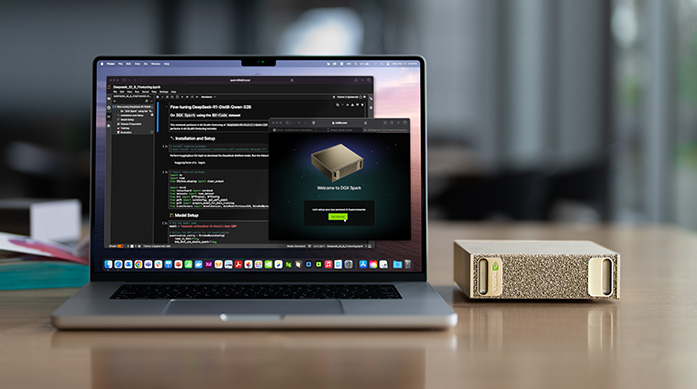
1. Light a Spark
Get past this next sentence: All you need is a supercomputer. Most people have trouble visualizing the amazing effects of ‘Moore’s Law’, an observation about the exponential progress of computing technologies. Pictured above is a great example: a photograph of laptop computer next to a supercomputer. The small, speckled box is the NVIDIA DGX Spark Artificial Intelligence desktop supercomputer, available from Amazon for $4,700 (that’s $4,700; not $4.7 million). All a small Mass Media company needs to individuate the contents it publishes or broadcast is one of these (or similarly-price competing supercomputers such as the Asus Ascent GX10, or MSI EdgeXpert).
All these tiny boxes contain NVIDIA’s Blackwell supercomputer processor, the equivalent of IBM’s $33 million Roadrunner supercomputer, which was the world’s most powerful mainframe computer in 2008. Roadrunner consisted of 296 racks of computer processing units consuming 2.5 megawatts of electricity per hour, weighing 500,000 lbs. (22,700 kg); and taking up 6,000 square feet (56 sq. m) of floor space. By comparison, the Spark weighs 2 pounds (1 kg), is the size of a hardcover book, and uses 240 watts of electricity per hour (equivalent to two 1990s home light bulbs). There have been few better examples of how Moore’s Law has both miniaturized and made computing affordable than this tiny device.
The Spark’s 1-petaflop (‘peta’ as in 1,000 trillion processes per second) and 128 gigabytes of random access memory (RAM) can simultaneously process up to 200 billion (yes, ‘b’ as in billion) local parameters, which is computerese meaning that if there are ten million people living in your market area, the Spark can process up 200,000 items of profile information about each individual.
Any newspaper with a printing press during the 20th Century needed at least one technician called a pressman to operate that device. During the 21st Century, your media company will need at least one technology to program its equipment, if only for the initial setup. If you’ve some experience with the Ubuntu operating system, you can do it yourself. Otherwise, hire an outsider to install (probably technician fee $700 to $1,000) the following free software applications.
The Spark comes preloaded with software that gives it the capabilities to see and understand computerized images (scanned photos, videos, diagrams, etc.) and to operate via voice control as well as by keyboard. Visit a website such as Github.com where you or the technician can download for free into the Spark a Small Language Model (SLM) software program (such as Mistral 7B or Llama-3-8B). Once those are installed, you’re in business.
2. Don’t Forget the Past
The first thing to do is to upload your newspaper’s entire archive into the Spark. If you’ve already digitized the archive, excellent! But if the archive is instead on microfiche, you’ll ironically need to spend more money than your entire supercomputer! Microfiche is an obsolete 120-year-old technology which was never designed for digitization. You’ll need to purchase a dedicated microfiche scanner (such as the ST ViewScan 4, $6,500 to $8,000 new or typically $4,800 to $5,000 used). However, if the newspaper’s archive exists only in the most primitive form, namely printed stories glued onto typewriter pages, just load all of those sheets of paper into an inexpensive but robust scanner (such as $550 Epson FastPhoto FF-680W which can automatically scan 60 pages per minute). The SLM software in the Spark will read, analyze, and catalog each story, document, photo, diagram, image and spreadsheet you input. Your newspaper will now have a ready system that can instantly analyze the history of your community and provide thorough background research and historical context for new stories, as well as among stories your newspaper has published. Consider allowing consumers to access this archive (the Spark) for a subscription or usage fee.
Remember to always add any new stories to this archive, as well as supporting documents such as reporters’ notes, local police blotters, town zoning and construction permit applications and decisions, local government and school board minutes, births and obituaries, local schools’ sport box scores, and anything else that might support or suggest new stories. Remember, too, that the SLM software can analyze this wealth of current and historical data to find otherwise unknown or unrealized links that lead (i.e., data journalism) to more new stories. I’d also advise inputting into the Spark all wire service, supplementary, and syndicated electronic sources of stories received by the newspaper.
2. The Agency
Great start, but there is one more important step to take. Are there any government agencies, undertakers, hospitals, or other organizations from which your reporters routinely obtain information (such as police blotters, school lunch menus, births and deaths, building permits, real estate sales, etc.)? You can save work for your reports by using the Spark as an electronic repository where those organizations can send that information and to create an electronic squadron of newsroom ‘micro agents’ to retrieve that information from the organizations. Such agents are known as Agentic Artificial Intelligence (AAI). Give the Spark its own email address (and tell it to verify from Internet Protocol address the sender’s identity before processing the contents to avoid spoofing or fraudulent inputs). If some of those agents can’t be persuaded to send you that information routinely, ask Spark to create ‘agents’ that routinely search and obtain that information from those organizations’ public websites. When asking Spark to do that, have it also alert the appropriate journalist if the agents find certain things (e.g., violent crimes, court verdicts, etc.) of note. (At the time of this writing (May 12, 2026), I’d also suggest editors, even those without tiny supercomputers, utilize programs such as Google’s Gemini Enterprise Agent Platform, Utilizing Google’s web-based supercomputer, this project instructs how any commercial enterprise can launch hundreds of AI ‘agents’ and “ensure control, governance, and security as you scale.”)
3. Start Neighborhooding
Now is the time to start offering individuated services to the people of your community. This can be done as individuated newsletters or by individuating the home page of your newspaper’s website. I suggest first offering individuated newsletters. This requires less programming than does individuating the home page. What contents to offer? Would people who live in specific villages, neighborhoods, developments, or regions of your community like to receive certain types (or all) news and information specifically about where they live? Births, deaths, building permits, crimes, fires, school events, etc. Such hyperlocal news and information (the type your reporters or the supercomputer ‘agents’ collect) doesn’t appear often in your newspaper’s edition because there isn’t always sufficient page space to justify publishing it. But the Spark can create and operate targeted emailed newsletter for each location. Consumers would merely need to provide their email and postal addresses, plus perhaps select from a checklist what types of information they want, which allows Spark to begin building a database of their names, addresses, and interests. Whether to offer such newsletters for free or a subscription fee is up to you. (Note that a free service is much more likely to build a consumer database faster.)
Would your newspaper’s consumers like to see their selections of stories on your newspaper’s home page rather than see the same home page every other visitor sees? There are large numbers of software programs (primarily developed for retails) that can be loaded into the Spark to do that.
4. Bespoke Individuation
You can now also choose to offer bespoke individuation rather simply allowing consumers to select from a checklist of topics. The consumer can make such choices either on a recurring or one-time basis. The consumer merely needs to send the Spark a query by email or you can offer a portal to the Spark on your newspaper’s website). The Spark will analyze and answer the consumer’s request, adding that to its database about that consumer. Using this mechanism, it’s even possible for a consumer to create their own ‘Daily Me’, a totally customized feed of items. Would your consumers be willing to pay a subscription price for that?
5. Bespoke Journalism
You might have noticed that we haven’t yet asked the Spark’s Artificial Intelligence to write any stories. Hundreds of newsrooms and journalism schools around the world are currently experimenting with Artificial Intelligence for that purpose. As a former owner of a daily newspaper and one with some expertise in these new technologies, I’ve been advising editors not yet to have AI systems write stories. The legal liability is still too high. The ‘hallucination’ (i.e., error) rates of AI are still as high as 2 to 3 percent. I believe those will diminish to less than 0.2 percent within three to four years and might become miniscule thereafter.
However, this doesn’t mean that I haven’t been advising newspapers to allow AI to re-rewrite stories in three specific ways:
· Custom Focus: Is a household which receives one of your emailed newsletters the home of a student who plays on a school sports team? The Spark can be programmed to rewrite the game stories received by that household as stories focusing more on that student (e.g., ‘Despite strong work by shooting guard Billy Jones, the Eagleville Eagles lost to the Putnam Falcons 54 to 62’) rather than receive the otherwise generic story about the game.
· Multilingual or Multilocational: because the Spark is capable of translation, a recent immigrant can receive stories in his native languages rather than the local language version. Or perhaps a subscriber wants information about more than one location. For instance, my wife was born abroad and wants to received news not only specifically about here but also about there. A similar example is that I’ve owned a beach house 30 miles (50 km) from where I live and want to receive neighborhood news from both those locations, etc.
· Format: a subscriber can choose to receive news stories rewritten by the Spark in the form of short summaries; another subscriber who has a Ph.D. can receive lengthier stories featuring deep analysis; and a teenager could even receive news stories as comic strip-style illustrations.
Ai doesn’t change the facts of these stories. Moreover, here are three things to keep in mind when offering individuation of contents”
First, the individuation offered need not be total. The concept is not a binary choice between all or no individuation. A spectrum exists. Any editor who wants to ensure that everyone in his community becomes informed that their town has been sold to Albania can program the Spark to ensure everyone in town sees such bulletin-level stories. The editor controls the degree of individuation offered.
Second, yes, offering individuated, rather than only general-interest, products and services will lead to some consumers to enter informational ‘bubbles’ or ‘echo chambers’ in which they choose to receive only information that reinforces their preexisting beliefs and prejudices. That effect already occurs in social media. It is an unfortunate flaw in human behavior. Yet isn’t that a fair price to pay for other consumers receiving more relevant and more engaging selections of contents than they’d ever gotten before? Remember my point above: the degree of individuation offered consumers is up to the editor.
Third, there is no theoretical reason why individuation cannot be offered in print. You might not have realized it, but you’ve probably been receiving mass individuated contents for decades. Every bank, credit card, and utilities statements you receive via postal mail is individuated. Those are printed on digital presses: computerized-controlled giant ink jet printers that print as fast as any newspaper press. However, I think that it is far easier to deliver individuated contents online than by postal mail or newspaper delivery.
- Scale Up
As the sheer numbers of consumers receiving your company’s individuated newsletters or individuated home pages increases, and likewise the degree of customization for each, your company’s individuation infrastructure will need to be strengthened and increased. You might need more than one networked Spark. You might need to use Large Language Model (LLM) software rather than the smaller SLM. The main bottleneck against larger scalability will be the media organization’s existing server connecting to the Internet. To process tens or hundreds of thousands or millions of individuated newsletters or archival requests, a Real-Time Data Streaming server (such as using Apache Kafka) might be needed. The technology of Retrieval-Augmented Generation (RAG), which relies upon multiple rather than a single database will also help. And for very large numbers of consumers, the Spark ultimately will have to be replaced by use of Distributed Cloud Architecture Edge Computing to avoid centralized bottlenecks and delays.
6. Marketers & Advertisers
Although I’ve worked as a journalist and media executive at UPI, Reuters, and News Corp., and have consulted mainly to news organizations, I’ve owned and operated a daily newspaper long enough to know that a significant portion of consumers read newspapers mainly for the advertisements rather than for news. More than 40 years ago, the Newspaper Advertising Bureau reported this was between 35 and 40 percent of readers. Although newspapers have lost much of their advertising business to CraigsList, Monster.com, and other online service, recent surveys nevertheless show that 61 percent of people trust advertisements in newspapers more than they trust ads online, and that printed ads receive a 9 percent response rate compared to online ads (including those in social media).
So, I suggest experimenting with provision of product and service information in those individuated newsletters. See if there is willingness and technical capacity among the community’s retailers for that. Can auto dealers provide the newspaper’s AI with information about their inventories of new and used cars for sale? Or can an AI’s ‘agents’ obtain that information by scraping it from the dealers’ websites? And from other types of businesses, the inventory of houses for sale or rent, apartments, etc. Would any local consumers want to be alerted if a seller drops the prices to what a consumer considers an agreeable price? The local newspaper used to be the central hub of information about products and services in its community for information. Can that situation return? It’s worth an experiment to find out.
The mistake that monks in scriptoria made more than 500 years ago when faced with Gutenberg’s invention of the printing press was that they didn’t themselves purchase and begin operating such presses. They myopically believed that their purpose was to sustain hand production of Bibles and forgot that their actual purpose was to spread ‘The Word of God’. Had they begun using the new technology that was taking away their business, they would still be in that business and perhaps still dominating it. Mass Media executives must avoid a similar mistake in the face of computer-mediated individuation technologies. Utilize the new technologies that your former consumers left you to use. You’ll stay in business much longer.