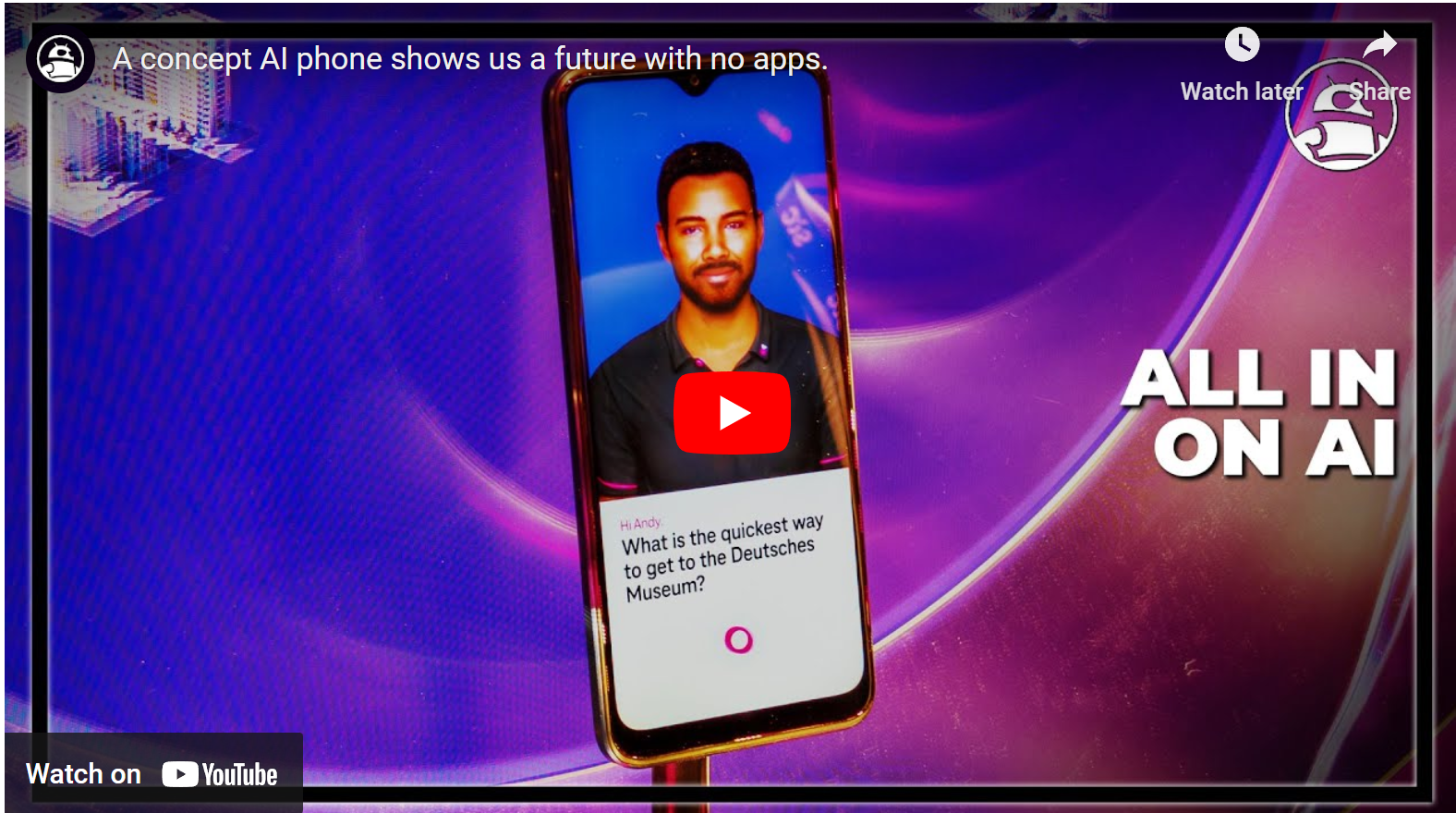
I wholeheartedly agree with this five-minute video story by Android Authority that the smartphone of the future won’t have or use Apps (i.e., individual single-purpose software applications) but instead simply use Artificial Intelligence (AI) to communicate/find/view.obtain/what its users wants.
<em>The Atlantic</em> monthly magazine <a href=”https://www.theatlantic.com/technology/archive/2018/05/touchtunes-digital-jukebox/559784/” target=”_blank” rel=”noopener”>reports how</a> a music individuation app called TouchTunes means the music a person oat a ‘dive bar’ is no longer the same music any other patron at that bar simultaneously hears. “An app, however, unlike…
The world’s longest-published newspaper will become a non-printed, totally online service nine weeks from now. On 20 December, Lloyd’s List, which has been continuously published since 1734, will no longer be available in print. It’s online edition for the Web have has…
How will journalists could use Google Glasses ? It’s the wrong question. The right question for journalists to ask is how and why will people who consume media use Google Glasses (or similarly wearable optic interfaces)? Whenever I encounter media professors or…
How the Apple iPad makes the placebo of convergence easier for newspaper executives to swallow.
Here are some savvy articles about how media is changing, will change radically, and why its companies might not be adapting to change.
A placebo called the convergence strategy has been willingly swallowed by most media companies and the media industries.
We live amid the greatest change in the history of media. Most media executives fail to recognize it and mistake its traits as the change itself.
Nokia’s Life Tools project is an intriguing addition to news organization’s mobile palette.
It is ridiculous that most media companies’ entertainment or lifestyle guide sites aren’t useful from mobile phones.
ABC’s World News Now is the most popular news podcast.
People e-mailed the BBC with more than 6,500 photos or mobile phone video clips of the inferno at the Buncefield oil depot explosion yesterday. According to MediaGuardian, this set a new record for emails sent to the BBC in the aftermath of…
Congratulations to Adrian Holovaty, Matt Thompson, and Inform Technologies. Boos to U.S. newspaper corporations for claiming that newsprint price increases are forcing them to cut staff (an excuse that Slate’s Jack Shafer roundly debunks) and boos to FIFA for banning immediate online publication or broadcast of digital images of the next World Cup.
Nokia predicts the future of mobile phones in 2006, 2007, and 2009.
Hitachi plans to begin selling a color-capable electronic paper in 2006. Rather than use organic light-emitting (OLED) diodes, the way that Philips’ e-paper does, Hitachi’s device will use a liquid crystal displays (LCD) 3-centimeters thick and equipped with a special panel that…
Speaking of 3G (below), BBC technology analyst Bill Thompson, at first skeptical of 3G, compares it against iPods and changes his mind. Among his comments: But just as the World Wide Web was the “killer application” that drove internet adoption, music videos…
Vodafone Ireland has released its pricing list for 3G broadband mobile phone customers: Unlimited access to Barclays Premiership goals, match previews and post-match interviews for ?9.99 per month. On a promotional basis, that service will be free to customers until February 2005.…
A month ago, I’d mentioned Nigel Pocklington‘s appointment to the newly created role of director of online publishing for the Financial Times. From London, Kieren McCarthy points me to an article he wrote today in The Independent about Pocklington’s role at FT.com…
When I emphasize how important mobile devices will soon become to online publishers , I speak from the experience of a user. I’m on the road about 14 days each month, and I can now leave my laptop at home. In August…
The annual IFRA/WAN/FIPP Beyond the Printed Word online publishing conference was held in Prague yesterday and today. A summary of the presentations is available from WAN and there is an interesting conference moblog. Here from the conference (my thanks to the IFRA…
US Magazine later this month will launch a subscription SMS service for celebrity junkies, reports Technology Marketing magazine. US is targeting this service at educated, relatively affluent, North American women with an average age of 32 who live in metropolitan areas. Called…
A Mobinet report says that 49% petrcent of mobile phone users worldwide have Internet access (eMarketer has a story about it). Mobile Internet access is 80 percent in Japan, 47 percent in Europe, and 37 percent in North America. Mobinet is a…
I keep telling publishers that electronic paper isn’t science fiction but science fact, technologiy that will go into commercial production this decade. I’m particular a fan of the rollable versions. For example, the picture above is of Polymer Vision B&W prototype demonstrated…
Many Many North American media companies plans to deliver news via mobile phones, yet none are exhibiting or on the presentations program at CTIA Wireless 2004> in Atlanta, which with more than 70,000 attendees claims to be ‘the world’s largest conference of…
Camera phonesare revolutionizing is public adoption of Multimedia Message Systems (MMS) in the U.K. The Enpocket Mobile Media Monitor found that during the the past 3 months the number of consumers using MMS surged by 40%. That surge was driven by 18…
Steve Outing has a good story today about most online newspapers’ woefully rigid and cluttered graphical user interfaces, the design equivalent of shovelware. He quotes Howard Finberg of the Poynter Institute (as is Outing) and the Digital Futurist consultancy and Nik Wilets…
Time Warner’s Sports Illustrated Magazine will offer American and Canadian mobile phone users their choices of phone ‘wallpaper’ from the magazines annual Swimsuit edition. SI signed the deal with Summus of Raleigh, North Carolina, a mobile phone technologies applications service provider.
The San Diego band XFYA has produced what apparently is the world’s first music video shot entirely on a camera phone (right). Entitled Haber Get Down from the band’s upcoming album Late Night at Denny’s, the video is of the greatest quality,…
The Mobile Marketing Association has released its ‘Code of Conduct for Wireless Campaigns‘. We think that online publishers should fit within this code, if not do even better. The MMA Code’s pertinent points: Choice Consumers must “opt-in” to all mobile messaging programs.…
The Financial Times will offer free and paid content to Vodaphone network mobile phone users in the UK. The format will be WAP. However, users will have free access to FT.com
A fellow member of the Online News Association mentions that the phrases online news and online publishing won’t make much sense in an increasingly wireless world. Speaking of which, Anil de Melo charts how mobile phones are evolving into ‘advanced human communication…
The Walt Disney Internet Group has contracted with Summus, Inc., a North Carolina developer of wireless multimedia applications, to provide Disney’s ABC News and ESPN subsidiaries’ content to users of some the non-GSM wireless networks in the US. Summus’ press release says…
FastCompany.com features a transcript of the mobile marketing panel yesterday at the Ad:Tech conference in NYC. Did you know that approximately 30 million Americans are using text messaging? That 150 million US mobile phones can receive text messages? Or that 80% of…
CyberAtlas today provides us with the following update on mobile content access: Instat/MDR expects the number of worldwide wireless Internet subscribers will have risen from 74 million at the end of 2001 to more than 320 million by the end of 2006.…
The US company known as Mazingo (Please note: not the UK company by the same name, so below), which offered magazine and broadcasters multimedia content to owners of Personal Digital Assistants (PDAs) has closed. The one year-old, San Francisco company’s Web site…
The New York Times is now offering almost every of daily news stories and some daily photos to users of Verizon’s mobile phones. Mobile subscribers can also use their handsets to e-mail NYT articles to friends and save NYT photos for use…
A study by the Radicati Group consultants believes that wireless e-mail will increase US corporate employees’ productivity, giving them 55 minutes extra working time per day this year and up to 80 minutes per day by 2007. eMarketer provides a briefing about…
Maxim, Blender, and Stuff magazines have launched mobile phone portals to distribute their branded ringtones, sound effects, images, games, and applications. The mobile wireless portals (for example, Maxim‘s) feature content such as Beyonce’s Crazy in Love and Justin Timberlake‘s Senorita set as…
Earlier today, we reported a case of a sports league disintermediating news companies from the process of delivering sports news to online consumers. Here’s another example, this one involving wireless phone users. A year ago, we reported that Nokia had chosen not…
The Yankee Groups predicts that US wireless penetration will reach nearly 50 percent by the end of this year. “North Americans now treat wireless like a utility rather than a novelty,” and that “With the current state of wireless competition, it is…
MTV has begun to stream music videos and other programming, such as Jackass and Dirty Sanchez, to users of Hutchison’s third-generation mobile phones in the UK, Netimperative reports. Premiership football game clips are already available on those 3G phones. However, Hutchinson has…
The growth of i-mode, increased services utilizing general packet radio service (GPRS) networks and the introduction of 3G are changing the user experience for Western European mobile phone users, according to a report available to eMarketer subscribers: “The migration from 2G mobile…
Most Danish newspaper boys want to have a mobile phone, so why give them those phones to help them better deliver newspapers? That’s a concept Sonofon and Dansk Avis Distribution (DAD), which distributes a variety of daily newspaper in Denmark, are implementing…
Nokia claims that use of e-mail on mobile phones will grow by 35 percent during the next 18 months. The Register thinks Nokia’s prediction might be somewhat high and quotes an analyst who believe that 10 percent growth would be more realistic.
Textually.org tells us that the North American wireless phone network Nextel will be offering live SMS alerts from National Hockey League games. A subscribers have a choice of receiving alerts when his favorite NHL team’s scores, or end-of period results, or end-of-game…
Some details from the Economists‘ story about Italian mobile phone use: Usage of a what the Italians call at telfonino may exceed 90% of the Italian population this year (perhaps only use of pasta eclipses it). More than half of Italian children…
Our presentation on The Wireless World panel yesterday at the Seybold-Romano Future of Print Conference, is available for
Because American publishers & consumers are far behind those in rest of the world when the topic is news by SMS, we heartened and not surprised to see progress in the American heartland. The reason we’re not surprised is that the news…
KPN, the Dutch phone company, has licensed CNNlive, a downloadable Java application that gives KPN’s i-mode mobile phone customers access to the top 10 stories from CNN.com’s international edition.